-
Horses and Mules WANT Strong Leaders
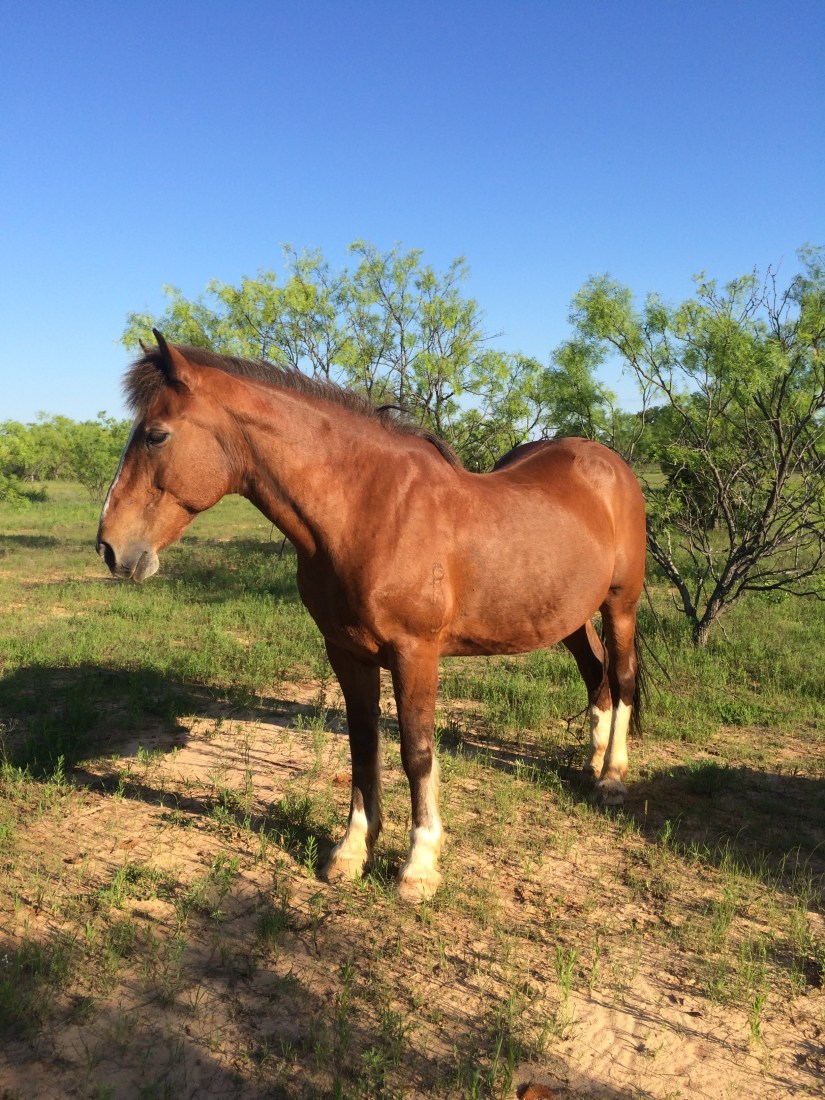
I’ve introduced many people to horses and horse training over the years, and all of them have had one thing in common: they start out being too nice.
People who know me are usually surprised to hear me say that, because I’m about as nice as a person can get. So why wouldn’t I want people to be nice to horses? Because that’s not what the horses want or need.
In a previous post, I talked about herd dynamics and how leader horses assert themselves by moving the feet of the lower-ranking horses.
You might think that the lower-ranking horses would resent the leaders for pushing them around. But the truth is just the opposite. Having strong, assertive leaders makes horses feel safe and secure.
When a human works with a horse, they form a herd of two. And even in a herd that small, there must be a leader. If the human doesn’t display leadership behavior, the horse will assume leadership himself, even if he’s normally a submissive horse. Because, in his mind, the safety of the herd depends on it.
So what does leadership behavior look like?
A good horseman approaches a horse confidently. He walks into the horse’s personal space calmly, but without hesitation. He puts the rope or halter on gently, but he doesn’t ask permission. When he moves, he doesn’t wonder if the horse will follow him—he just believes it will. He leads and expects to be followed. If the horse doesn’t comply, he applies some form of pressure until the horse moves. Just like a dominant horse would.
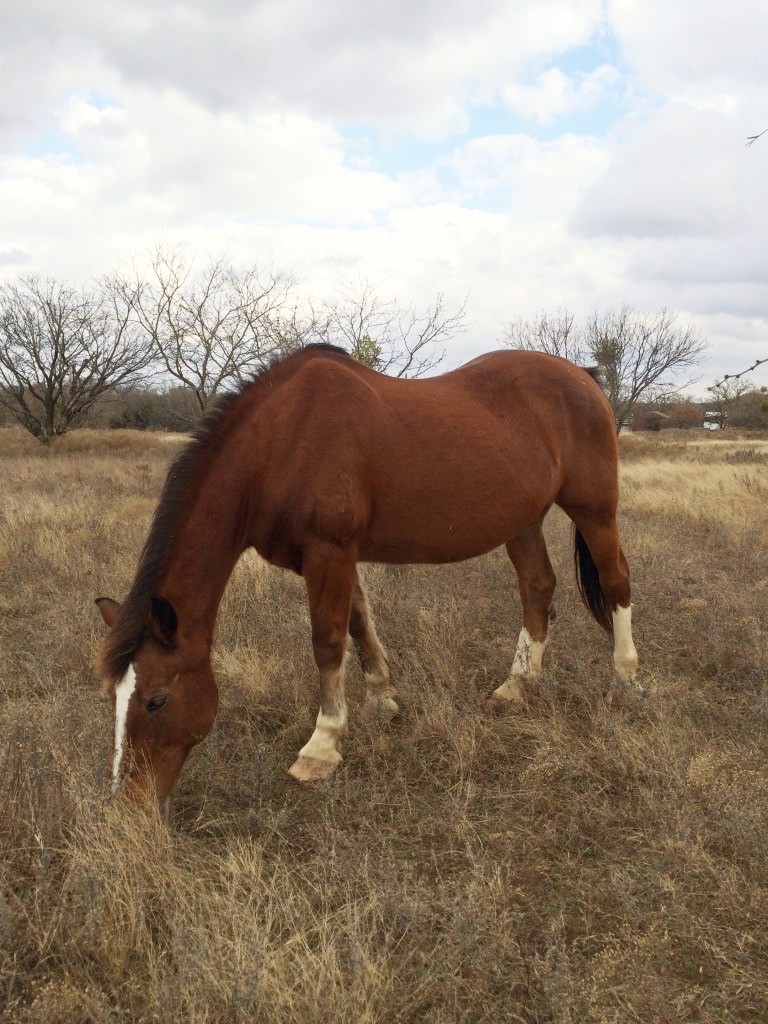
Rhona was the epitome of a strong leader—tough but fair In contrast, how do most beginners approach a horse? Timidly. They hesitate in their approach, essentially asking the horse for permission to come into his space. If the horse gets too close, they move out of his way instead of making HIM move. And that’s all it takes for a horse to decide that this person isn’t a leader.
So it escalates from there. The horse starts getting pushier. He mugs the human for treats. He tries to pull away when the human is holding the rope. He swishes his tail when the human gets near. Maybe he even bites or kicks.
In a herd, the higher ranking horses would IMMEDIATELY squash such behavior, and so should the human. That might mean making the horse back up, running him in small circles, popping him with the end of a rope, or even slapping his mouth (in the case of biting).
Done in a reasonable manner, none of these things are the least bit abusive or harmful. But beginners balk at them. They don’t want to hurt the horse (pretty much impossible—horses are a lot tougher than most people think) or make him hate them (also not an issue because, as we’ve discussed, horses naturally understand fair and appropriate discipline). They want to be nice.
Nice owners have probably ruined more good horses than cruel ones have.
But just in case there’s any confusion, I want to emphasize that niceness does NOT equal kindness. Niceness does NOT equal compassion. Niceness does NOT equal patience.
Good owners are kind and compassionate and patient with their horses. They provide love and affection and comfort. But they also provide structure and boundaries and discipline.
And their horses love them for it.
-
Befriending My First Donkey
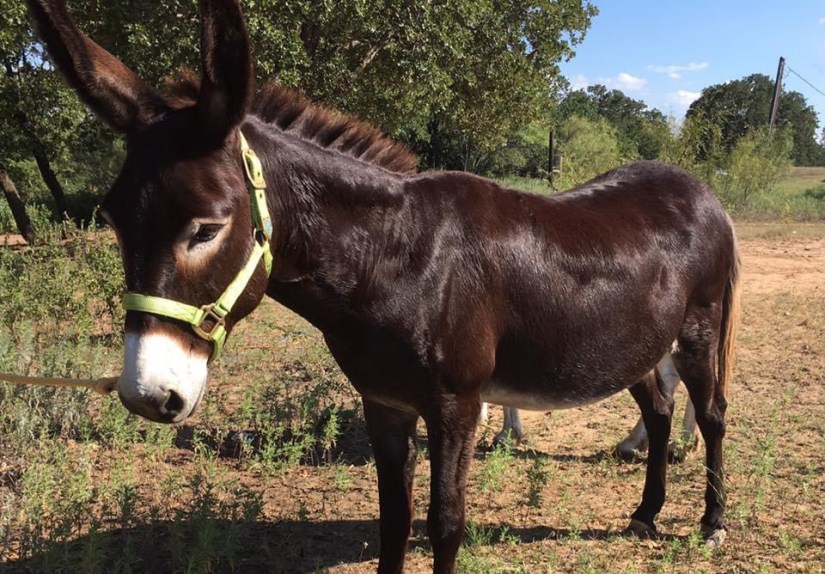
Despite being obsessed with horses since the early 80s, donkeys were largely off my radar until 2010. That’s when I saw some pulling carts at the state fair horse show—the first donkeys I’d seen in real life—and I was instantly in love. Who could resist those ears??
The following year, we were having trouble with dogs getting into the pasture and chasing the horses. That’s when I first learned that donkeys are often used to protect livestock from dogs, coyotes, and other predators.
Soon after, a large goat ranch nearby shut down and was selling all its guard donkeys for $25 each. When I called to reserve one, the owner emphasized that these were NOT pets. Most of them had been born out in the field and had no human contact. They were feral, essentially.
So we arrived, opened the trailer, and a ranch hand chased a dark brown jenny into it.
Back home, we opened the trailer door and she was gone in a flash. I wondered how long it would be before I could get that close to her again.
Spoiler: Not nearly as long as I thought.
Day 1
I figured the logical first step was to let her get used to seeing me. So, the next day, I took a lawn chair and a book into the pasture, and I sat there and read for a couple of hours.
And that’s when I discovered how incredibly curious donkeys are.
She was wary of me, but she was also fascinated. She kept me in her line of site as she grazed, and I’d catch her staring at me when she thought I wasn’t paying attention.
By the time I left, she’d slowly drifted from a few hundred feet away to less than 20.
Day 2
We continued the game the next day, and this time she didn’t bother with the aloof act. She immediately came within about 20 feet. So I started talking to her. Introduced myself, told her all the horses’ names, sang a few songs—everything in a casual, calm voice. And sure enough, she continued to get closer.
After an hour or so, she got close enough to sniff my chair, and then my book. I slowly reached out and touched her shoulder, but that sent her skittering away. Not in true fear, though. It was more like “I need to step away and think about whether I’m okay with that.”
I’d later learn that that’s what donkeys do—they think. They think about EVERYTHING. And you’re going to get nowhere with them unless you allow them that thinking time.
A few minutes later, she approached again. This time she let me touch her for a few seconds, then she went back to her grazing.
Day 3
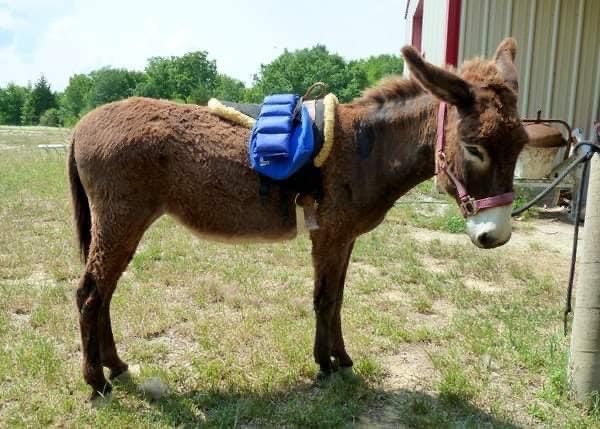
This was a few months later, when I started training her as a “pony” for my toddler niece, but you can see that her coat was still in pretty rough shape… The third day, I decided to see how she’d react to me approaching her. She let me get within a few feet before she started looking nervous, so I stopped there. When she moved to a new patch of grass, I followed and watched.
Her coat was very rough and dry, and I’d noticed her scratching a lot over the last few days. Especially on her lower back, which she had trouble reaching with her teeth.
And that’s when I had possibly the best idea I’ve ever had in my life. I walked up a little closer, stretched my arm out, and scratched her in the spot she’d been trying to reach. I have long fingernails, so I’m really good at scratching.

…nothing at all like the beautiful, shiny girl she would become. ❤ You could almost see a giant light bulb go on over her head as she realized I might actually be good for something.
I continued to stay close, and eventually she started scratching another itchy spot. So I scratched that one, too.
Day 4
On the fourth day, I was shocked to see her waiting at the gate.
I walked in, and she positioned herself so that I was in easy reach of her lower back. She used her muzzle to point at a spot, then she looked at me expectantly.
THAT’S how smart donkeys are.
That was 12 years ago. Since then, I’ve provided frequent scratching assistance, and she’s willingly done everything I’ve ever asked her to do.
Best $25 I ever spent.
-
We Get There When We Get There
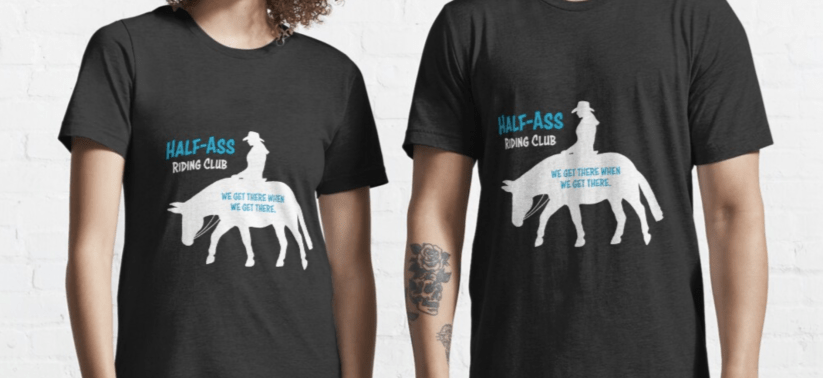
As I’ve mentioned, donkeys and mules tend to do things at their own pace. And that pace usually falls somewhere between ambling and glacial. So a slogan popped into my head one night: Half-Ass Riding Club — We Get There When We Get There.
I originally meant it in a literal sense, about mules being half ass (donkey) and somewhat slow.
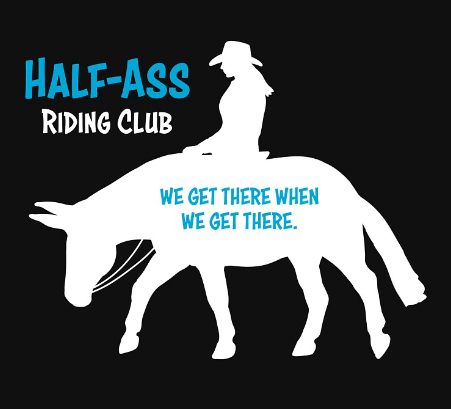
Later, I realized there was a second meaning, about being a half-ass rider and not caring how fast or far my mount goes.
Much later, it dawned on me that there’s yet a third interpretation for those of us who are living out our riding dreams in middle age or older. It took us a while to get here, but we did get here. And that’s all that matters. 🙂
If you’re a member of the half-ass club in any sense (or would like to be), I’d love for you to purchase a shirt, decal, magnet, etc., designed by yours truly. There are versions with male and female riders.
All profits are used to spoil the midlife mule and her friends with treats, toys and salt licks!
Shop is here: https://www.redbubble.com/people/mabradshaw/shop?asc=u&ref=account-nav-dropdown
-
Getting Back in the Saddle
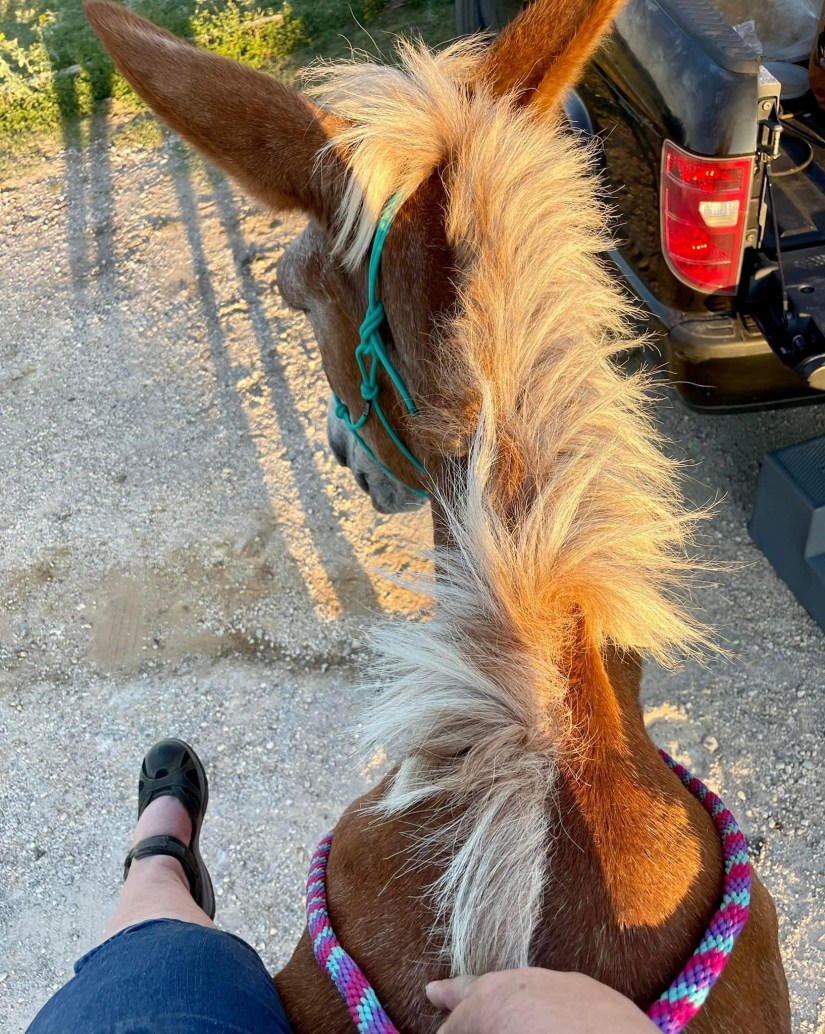
I’d like to tell you that I jumped up on Reina, felt like I was a teenager again, and we rode off confidently into the sunset.
But I’ll tell you the truth instead.
As I mentioned before, I was still healing up from a broken ankle when she arrived, so I had to wait a few weeks before I was cleared to ride.
But I found myself putting it off even longer. A few times I got as close as standing on the mounting block and putting my foot into the stirrup. But, every time, I froze up when it came time to throw my leg over.
I couldn’t even tell you why. By that point I knew her pretty well and trusted her not to do anything stupid. And she trusted me, too. I guess it was ME who didn’t trust me.
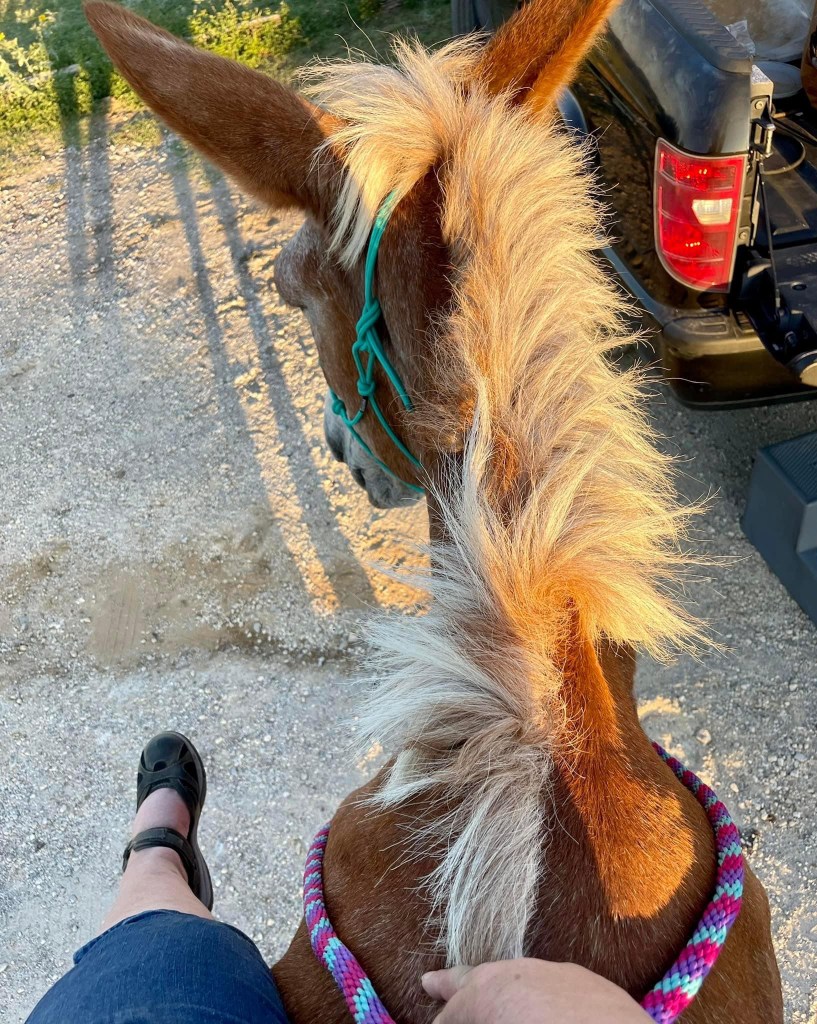
I snapped this photo just in case I was never brave enough to get on her again. But finally, one evening while hanging out with her, my inner 12 year old took control. I tied her lead rope into reins, stood up on my truck’s tailgate, took one big breath, then climbed over onto her bare back.
It took my inner 49 year old about three seconds to realize how incredibly stupid that was. But Reina had already stepped away from the truck, so I was committed.
I learned two things during that brief ride:
1. Sixteen hands seems a LOT higher off the ground than it used to.
2. Balance is one of those “use it or lose it” skills, and I lost it a long time ago.
But I survived. And a few days later I rode her again, this time with proper gear (boots, saddle, helmet).
That was a few months ago, and we’re still doing “baby” rides to build my skills and confidence—usually just walking slowly around the arena. But that’s one of the nice things about being a middle-aged rider: no one really expects you to accomplish anything! They’re just surprised you’re out there at all.
And my sweet Reina proves herself a saint of a mule on a regular basis. While I haven’t fallen off of her (yet), I’ve managed to fall UNDER her twice now. One of those times the saddle went with me. (I’d forgotten how often cinches need to be checked for tightness!) That’s a nightmare scenario with most horses, as a saddle hanging from the belly is likely to trigger a spook, possibly trampling the rider and injuring the horse. But my steady steed isn’t the least bit startled by my clumsiness and ineptitude. She just watches me curiously from the corner of her eye until I stop laughing, drag my ass up, and dust off the dirt.
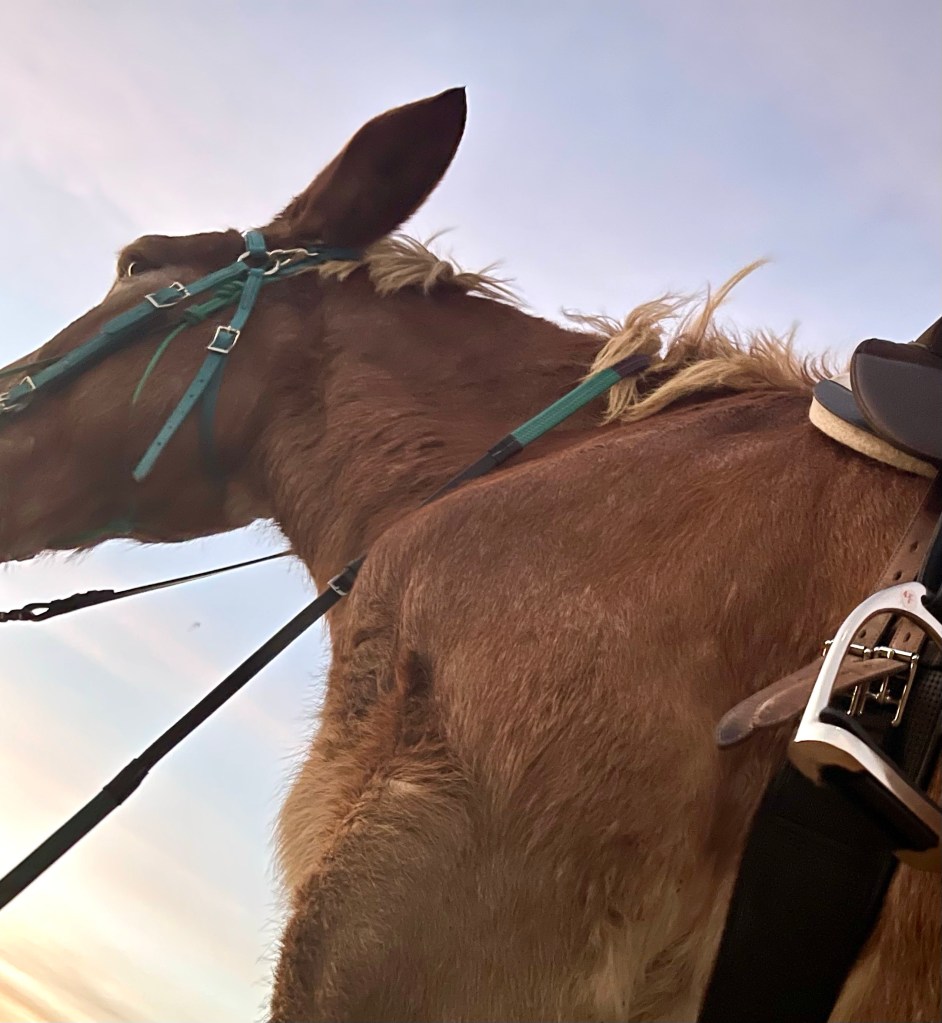
“Dude, you’re down there AGAIN?” -
My Heart Horse
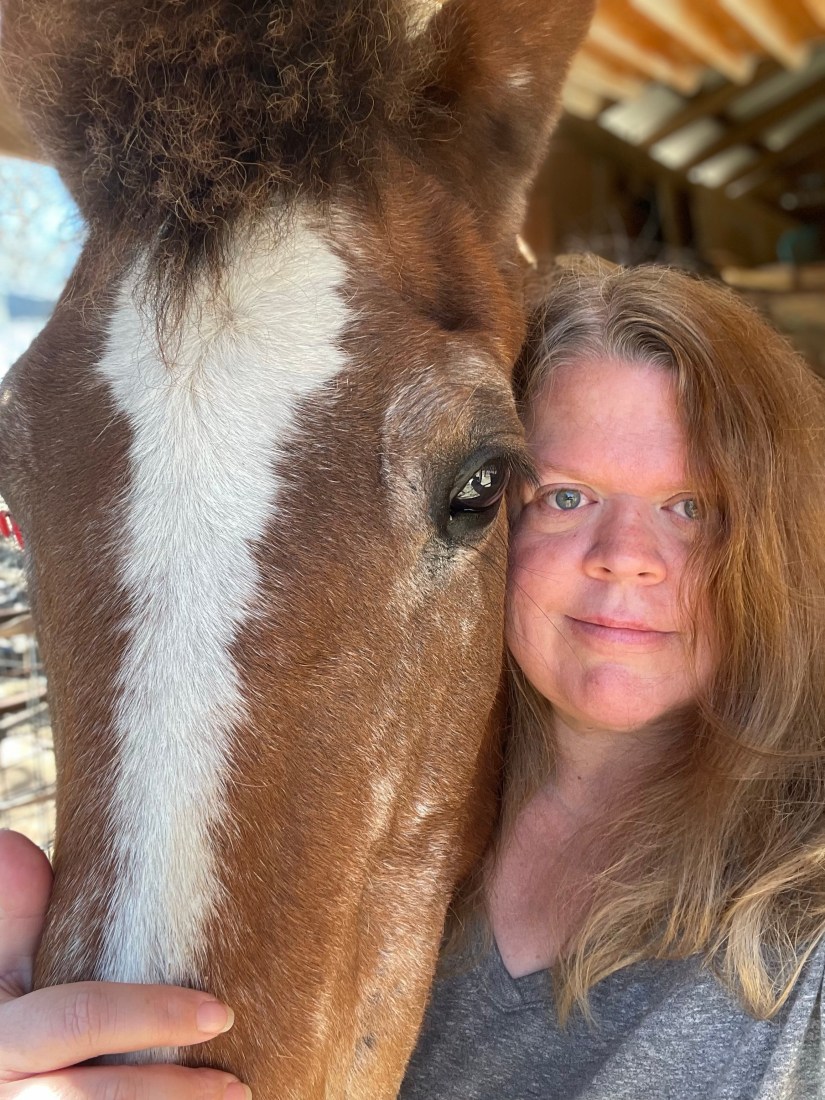
I think most horse people love all of our horses—even the ones we don’t particularly like. 😉 But if you’re really lucky, sometimes you get an extra special one that you connect with like no other. A horsey soul mate, if you will. We call those “heart horses.”
Rhona came into my life in 2006, when I impulsively decided to adopt a PMU mare.
For those who don’t know, PMU mares were used for decades to produce the hormone replacement drug Premarin (the name being a contraction of Pregnant Mare’s Urine). They spent most of their lives in tiny stalls, pregnant, attached to a hose that collected their urine.
In the early 2000s, Premarin was found to cause cancer, so most of the farms were shut down and the mares sent to auction. Since there was very little demand for full-grown draft mares with no training whatsoever, most of them were sold for meat.

My beautiful girl A rescue not far from me had just brought a load from Canada, and I immediately fell in love with a photo of a big black Clydesdale named Summer. But when I went to meet her, she wanted nothing to do with me. No amount of coaxing would get her to let me approach.
But as I followed Summer around the pasture, a bay mare followed me. She wasn’t what I wanted—not big enough or flashy enough—so I didn’t pay much attention. Even when she started nudging my back. But then I squatted down in a last attempt to woo Summer, and the bay mare leaned over me and put her head in my lap.
And that was that. I was hers and she was mine, and I’ve never regretted the decision for a second. Adopting Rhona (or Mare #4, as she was known then) was one of the dumbest things I’ve ever done on paper, but it was the best thing I’ve ever done for my soul. Getting to watch her learn to be a normal horse, to enjoy all the things that normal horses enjoy, was one of the greatest pleasures of my life.
Adopting Rhona was one of the dumbest things I’ve ever done on paper, but it was the best thing I’ve ever done for my soul.
It wasn’t always easy, though. Trying to teach a 12yo, 1300lb, VERY strong-willed horse to do things that are normally taught to babies was more of a challenge than I anticipated. But we were blessed to meet wonderful people who helped us along the way. So many dear friends, both in real life and online, came into my life because of Rhona.
Through those years, a lot of people wondered why I bothered. Why I didn’t sell her and buy an “easy” horse. But the answer was the same from our first day to our last day: Rhona wasn’t my pet, she was my friend. Even when we were struggling, we understood and respected each other on a level I’ve never experienced with another horse.
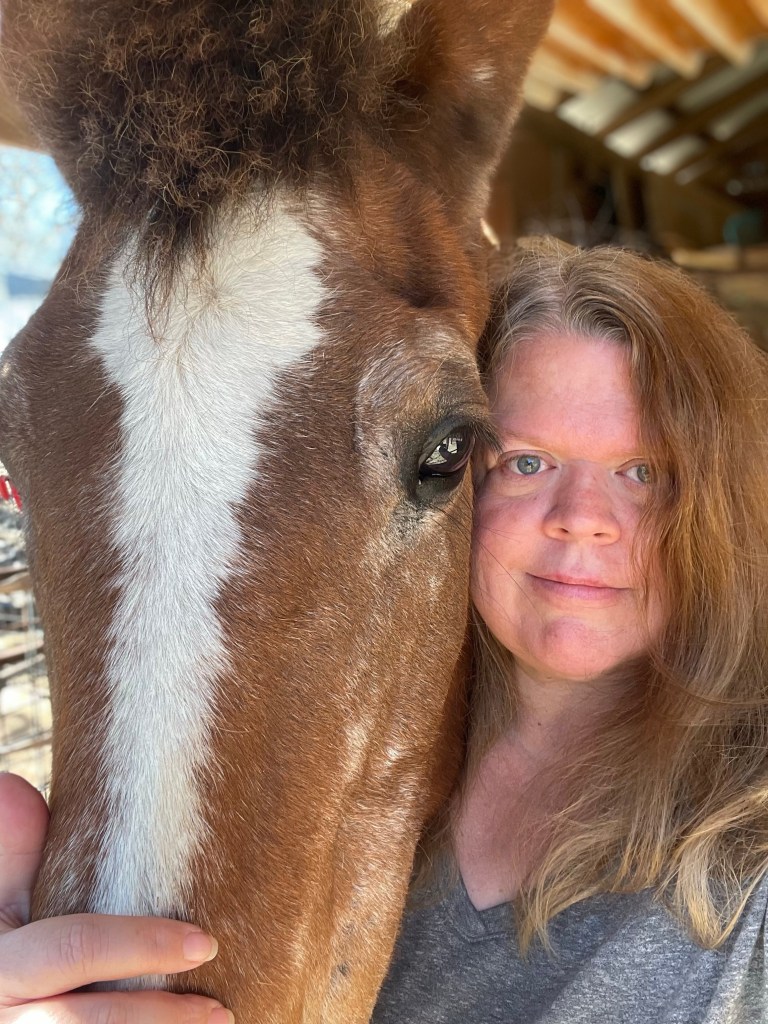
My last photo with Rhona I used to board her in a pasture with about a dozen other horses. She was always with them at the hay piles when I arrived, and 95% of the time she’d make me walk out there to get her. The other 5% were the days I’d show up sad or stressed or miserable in some other way. Those days she met me at the gate. She’d start walking toward me as soon as I stepped out of my car.
A fellow boarder once told me that if he could pick any horse to hang out at a bar drinking beer with, it would be Rhona. I laughed, but I knew what he meant. She was the kind of horse you could talk to, the kind of horse who would listen. And she listened to me through some very hard times.
That’s why it never really mattered that we didn’t get around to doing most of the things I dreamed we’d do, back when we were young. Just knowing she was happy and healthy and safe was enough to cheer me up on even the worst of days.
She’s the only horse I’ve ever loved that I’m sure loved me back, and I’m incredibly grateful that I was able to give her 16 happy years in exchange for everything she gave me.
Rest in peace, dear friend. Rhona, 1994-2022
-
Why a Mule?
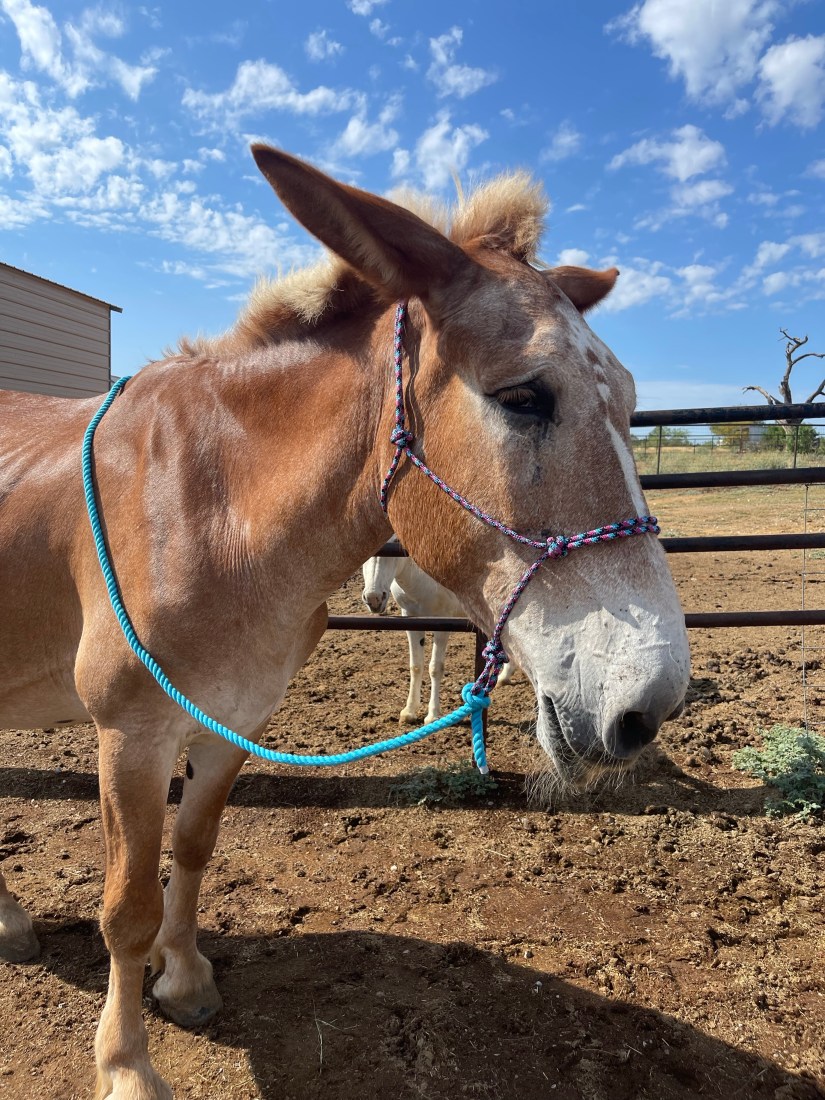
A lot of people wonder that, and I can’t blame them. Mules are usually viewed as funny-looking (or even ugly), stubborn, slow horses.
Some of those things can be true, at least subjectively. I find them beautiful, but obviously that’s very much in the eye of the beholder. And no, they’re not going to break any speed records (although there ARE exceptions, including the charming story of a mule named Lord Fauntleroy, who won the 3,500 mile Great American Horse Race in 1976).
As for being stubborn…that’s a little more complicated.
Before we get into that, let’s start by defining what a mule is. A mule is the offspring of a male donkey and a female horse. (In case you’re curious, the offspring of a female donkey and a male horse is called a hinny.) Nearly all mules are sterile, so you can only produce a mule by breeding a donkey and a horse.
So what’s the big deal? Isn’t a donkey just a small, fuzzy horse with long ears??
ABSOLUTELY NOT.
Donkeys look similar to horses, and they eat grass and hay like horses, but they’re VERY different animals. Most importantly, donkeys think and view the world in an entirely different way than horses do.
Let’s start with horses…
Almost all horse behavior is the result of being 1) a herd animal, and 2) a prey animal.
Horse herds always have hierarchies, and every horse is aware of exactly where he falls on the social ladder. Higher-ranking horses show their dominance by controlling the movement of the lower-ranking horses. Sometimes this involves chasing, kicking or biting. Usually, though, it’s much more subtle—pinned ears, tensed muscles, or even just a swish of the tail are enough to make the lower-ranking horse move away.
Most modern horse training methods are built on the same principle: controlling the horse’s movement to make him respect you as a superior. This is done by teaching him to yield to pressure—pressure of the legs, pressure of the bit, pressure of a rope, and even just the virtual pressure of dominant body language. (Don’t underestimate that last one! Although I definitely don’t recommend it, I’ve stopped more than one charging horse simply by stepping in front of him with an assertive stance and a commanding voice.) Pressure is the language they understand. And they’ll respond basically the same way regardless of who is applying the pressure, as long as it’s applied clearly.
The prey animal behavior kicks in when they get frightened. For millions of years, horses survived by quickly recognizing danger signs and immediately running away; and that flight instinct still exists in modern horses. It can be dulled through training and experience, to a certain extent. But, faced with something unfamiliar enough and scary enough, ANY horse will try to flee.
The point of the few paragraphs above is that horses make very few conscious decisions. Outside of their basic functions, like eating, drinking, exercising and socializing, the vast majority of their actions are either 1) moving away from some type of pressure, or 2) fleeing from danger.
And that’s NOT a bad thing, so please don’t think I’m slamming horses.
But donkeys are different.
Donkeys are THINKERS. Everything a donkey does is the result of a conscious decision.
When a donkey encounters something scary or dangerous, his behavior is the opposite of a horse. Instead of immediately running away, his instinct is to freeze and assess the danger. (He may THEN run away, but he’ll decide WHERE to run instead of just fleeing blindly.) But, depending on the nature of the threat, he may choose to stand and fight instead. The decision will be based on which option he feels is safer. That’s because donkeys have an incredible instinct for self-preservation. They’ll never voluntarily put themselves into a situation they feel might be dangerous.
And THAT is the root of the “donkeys are stubborn” myth.
Donkeys actually aren’t the least bit stubborn, in my experience. They just don’t blindly do as they’re told. That can look a lot like stubbornness if you’re used to dealing with horses and dogs.
So what happens if you try to train a donkey like a horse and expect him to yield to your pressure just because you said so? You get a donkey that simply shuts down and stops listening to you at all. I call that “rock mode,” because you might be able to push or pull him around at that point, but you’ll get the same response that you’d get from a rock.
Why does he do that? Because 1) he doesn’t trust you, 2) therefore, he can’t be sure that what you’re asking him to do is safe, and 3) you’re not giving him time to change his mind about 1 and 2.
To train a donkey to do anything, no matter how simple, you have to give him time to think and decide for himself whether he can safely do what you’re asking him to do. Sometimes a few seconds is enough. Sometimes it takes hours or even days. It takes as long as it takes, and rushing him will only reset the clock.
At this point you may be wondering why anyone would bother. But, thankfully, donkeys have some amazing upsides that can more than make up for their difficulties. For one thing, once they understand something, they never forget it. You don’t have to keep practicing like you do with a horse.
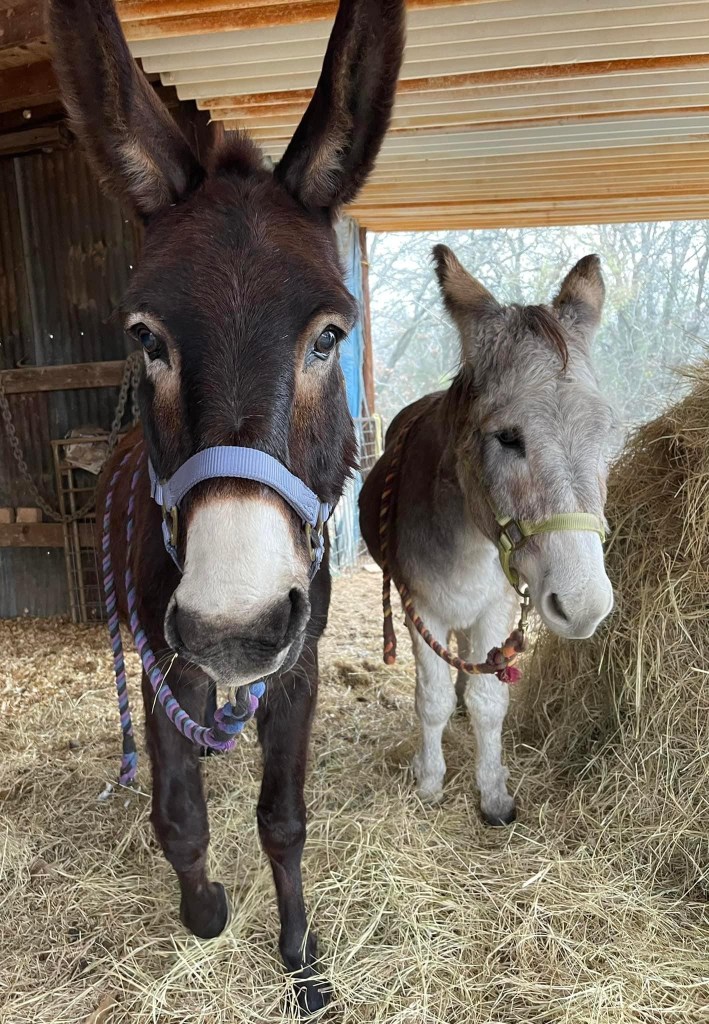
Did I mention that they’re also freaking adorable? Because seriously, they are. Jeep is on the left, Clyde is on the right. Example: The first time I tried to lead Jeep (my formerly feral jenny) into a barn, it took 30 minutes for her to take the six steps necessary to get her entire body inside. I let her look around for a couple of minutes while I praised her and gave her some treats, then we walked back out. On the second approach, she didn’t even hesitate—walked straight in, stopped in the same spot, then looked at me expectantly. (You can read more about Jeep here.)
The other big upside is that, because they’re so smart, it’s possible to develop very deep bonds with them. Once they trust you, they’re incredibly loyal and loving and affectionate, and they’ll do almost anything you could ask of them.
So what about mules?
It’s about time I finally get to that, huh?
So mules, as we discussed, are half donkey and half horse. And they managed to inherit most of the strengths of each side with relatively few of the weaknesses. They’re even superior to both parents in some ways!
Mules tend to get their size (and, to some extent, athletic ability) from the horse side, making them much more useful than donkeys for riding. But they get longevity from the donkey, often living significantly longer than horses. And they’re stronger than either parent, making them superior draft animals. They’re also healthier and hardier than horses, require less feed, and have more endurance.
Mules win on intellect as well, being more intelligent than both horses and donkeys. They have the donkey memory and sense of self-preservation, but they’re a little easier to train. And while they CAN spook like horses, they’re more likely to freeze and assess like a donkey would.
They also tend to be calm, friendly, and affectionate.
Horses were perfect for my younger self. They were the embodiment of grace and speed and beauty, and I couldn’t imagine anything better. But as my own grace and speed have faded, I’ve come to appreciate steady and slow, and these days I struggle to imagine anything more beautiful than my mule’s giant head, long ears and droopy lip watching for me over the stall door.
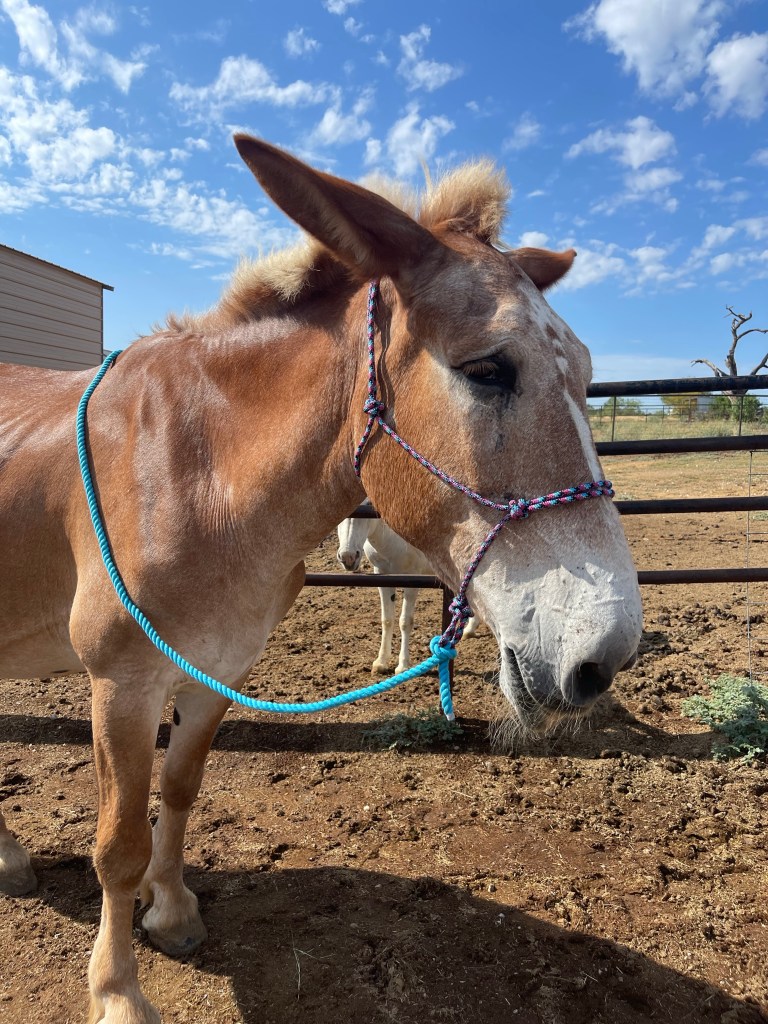
Just look at that sweet face. ❤️ -
The Midlife Mule
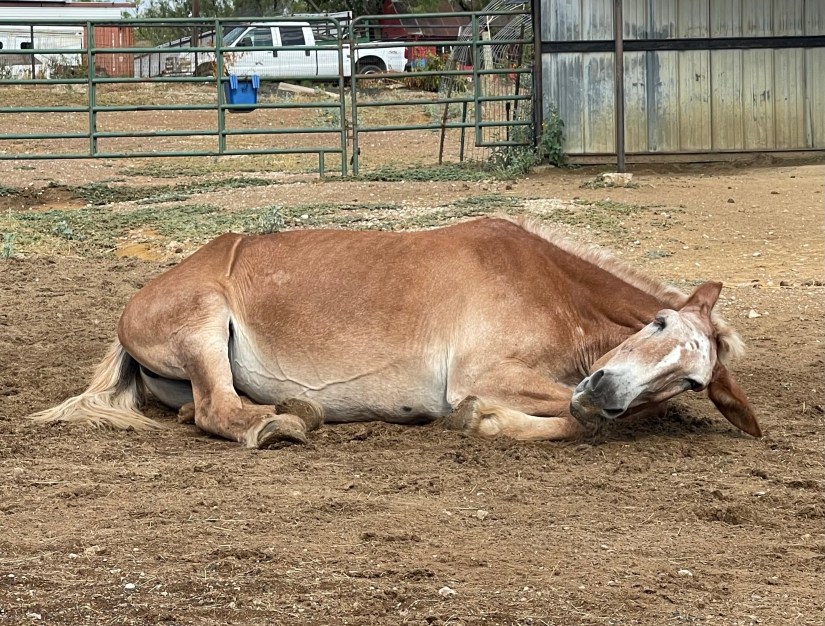
I was about five years old when I touched a horse for the first time. Some neighbors brought in a spotted pony from a relative’s ranch and invited all the kids to come take a ride. I remember being lifted onto the pony’s bare back and told to hang on tight, and the next thing I knew we were travelling at warp speed (or maybe just a moderate trot) in a circle around the yard.
It. Was. Terrifying.
But somehow I managed to stay on, and two or three minutes later the pony was halted so the next kid could ride.
That’s how they get us, those damned sneaky horses. For those of us who are susceptible, it just takes one tiny taste and you’re hooked for life. There’s no cure, and you probably wouldn’t take it if there was. By the time you realize what happened, it’s already in your bones and your blood and your breath. It’s part of who you are.
I was about 11 the next time I rode a horse, at a rent-by-the-hour stable my Dad took me to. (Best day ever.) By that point I’d read every horse book in the library and owned an army of toy equines. The infection…err, obsession was at full strength.
The following year, miracle of miracles, I got a horse of my own. And so horses occupied a huge part of my real life, not just my dream life, for the next decade and a half.
But, as legions of other horse girls have sadly learned, adulthood eventually starts getting in the way. I continued to own horses, but it became mostly passive ownership—providing resources and occasional visits for a string of “pasture pets.”
When the last of those (my heart horse, Rhona) passed away in early 2022, I thought I was done with horses and riding. After all, I was 49 years old, ridiculously out of shape, and had ridden only a few times since my early 20s. Besides, I still had two adorable donkeys to scratch the equine itch, and over the years I’d found that they made more sense to me than horses did anyway.
But life threw me a curve ball in June 2022. Within a single week, I caught COVID and broke my ankle in three places. I spent most of the next two months in bed, which gave me a LOT of time to think. And what I thought about, mostly, was how quickly life can change. A wrong breath, a wrong step, and suddenly you can’t do the things you love anymore. So you sure better enjoy them while you can!
And it slowly became clear to me that the thing I loved and desperately wanted to do again was ride.
Not like I did in my 20s, though, when I’d happily climb up on (and sometimes get bucked off) any horse that came my way. I can’t take a fall like I used to, and I’ve gained a LOT of fear since then. And, being self-employed, I literally can’t afford to hurt myself too much.
I wanted to ride something I could trust to be sane and calm and slow. And so, as I had MANY times over the years, I found myself looking at my donkey, Jeep, and wishing she was a foot taller.
Unfortunately, large saddle donkeys were way out of my price range, as were my second choice, Belgian draft mules (Belgians being, in my experience, the calmest and sweetest of horse breeds). And they very rarely came up for sale within 1,000 miles of me anyway.
So I was pretty surprised when I saw a Belgian molly pop up on Facebook one day. It was love at first sight for me, and her description matched my wishlist exactly: middle-aged, healthy, friendly, a little lazy, and calm enough for even the most timid or inexperienced rider.
Her asking price was more than I could afford, though, so I eventually forced myself to keep scrolling. But I kept a screenshot and daydreamed about her for the next couple of weeks.
Then I logged in one morning to see her ad at the top of my feed again. Only this time, the price was reduced to the amount I’d budgeted (which was a STEAL if her description was accurate), and the ad was only one minute old. No responses yet.
So I took a crazy leap of faith and did something that nobody in their right mind should do: I agreed to buy her right then and there.
I was still hobbling around in my boot cast when she was delivered a week later. And thus began the adventures of a middle-aged woman and a middle-aged mule.

The midlife mule, Reina, napping the day after she arrived

Musings about equines and life
 The Midlife Mule